Plantlet The Blogging Platform of Department of Botany, University of Dhaka
Algae is an extremely diverse group of organisms that make up the lower phylogenetic echelons of the plant kingdom. A precise definition of this group is elusive and they share many obvious characteristics with higher land plants, whereas their distinguishing features from other plant groups are varied and more subtle according to the classification of Bold and Wynne 1985. Bold and Wynne (1978) recognized nine divisions of algae retaining the nomenclature given by Papenfuss (1946), except for blue-green algae.
(To know about the second three divisions of Bold and Wynne (Euglenophyta, Phaeophyta, Chrysophyta) follow this link below:
Bold & Wynne’s Divisions: Euglenophyta, Phaeophyta, Chrysophyta
(To know about the last three divisions of Bold and Wynne (Pyrrhophyta, Cryptophyta, Rhodophyta) follow thils link below:
Bold & Wynne’s Divisions: Pyrrhophyta, Cryptophyta, Rhodophyta
In this article, the first four divisions of this classification (Cyanophyta, Prochlorophyta, Chlorophyta, Charophyta) will be characterised briefly:
Cyanophyta
- Common name: Cyanobacteria, BGA(Blue Green Algae)
- Habit: Cyanobacteria or BGA are unicellular organisms occurring in all types of water bodies including fresh water. brackish water and saline water. They are autotrophic in nature. According to some evolutionist they are the first group of organisms that initiated photosynthesis.
-
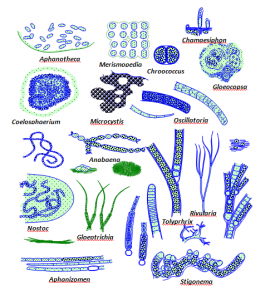
Some common Cyanobacteria. Source here.