Plantlet The Blogging Platform of Department of Botany, University of Dhaka
What is Micro-propagation?
Micropropagation is a method to produce genetically identical plantlets by using in vitro tissue culture techniques.
More specifically, Micropropagation refers to the in vitro multiplication and/or regeneration of plant material under aseptic and controlled environmental conditions to produce thousands or millions of plants for transfer to the field. So, it implies the concept of regeneration, multiplication & uniformity of mother explants/plants.
Vegetative (asexual) propagation occurs in nature
- Layering – a drooping lower branch contacts the soil (pressed down by snow or vegetation); roots form at point of soil contact forming a new genetically identical tree.
- When trees of some species are cut down, new shoots emerge from the stump.
- Strawberries spread through sending out above ground horizontal shoots called runners, also called stolons.
Micropropagation is the practice of rapidly multiplying stock plant material to produce a large number of progeny plants using modern plant tissue culture methods.
Micropropagation is used to multiply novel plants. It is also used to provide a sufficient number of plantlets for planting from a stock plant which does not produce seeds or does not respond well to vegetative propagation.
Why do Micro-propagation?
- A single explant can be multiplied into several thousand plants in less than a year.
- Once established, it can give a continuous supply of young plants throughout the year i.e. irrespective of
season. - Taking an explant does not usually destroy the mother plant, so rare and endangered plants can be saved somehow.
- Clones through micro-propagation are ‘true to type’ as compared with seedlings, which show greater variability.
- This allows fast selection for crop improvement – explants are chosen from superior plants, then cloned.
- Plant ’tissue banks’ can be frozen, then regenerated through micro-propagation.
- Disease and virus free plants can be produced through this technique.
- Greater credibility in international market as plantlets are produced through micro-propagation (Phyto-sanitary perspective)
How possible is this??
- Micro-propagation of almost all vegetables and fruit crops is possible.
- Some examples, mustard, corn, soybean, azalea, dwarfing sweet cherry, strawberry, mango, banana, rose, orchid, nutraceutical plants, rhododendron, citrus, potato, tomato, legumes etc.
- Hundreds of thousands of plants could be developed from one node.
- Since these are produced from axillary buds, the plantlets will be clones of the mother plant.
A single node will produce a shoot within 4-6 weeks t thathas 4-6 nodes.
Each plantlet can be “subcultured” to produce another 4- 6 plants each.
History of Micro-propagation
Toward Commercial Micropropagation 1950s
Morel & Martin 1952 : Meristem-tip culture for disease elimination
Morel 1960 : Disease eradication
Wimber 1963 : In vitro production of orchids
Dr. Toshio Murashige
Commercialization of Micropropagation 1970s & 1980s
Murashige1974 – Broad commercial application
Micro-propagation applications
✓Rapid increase of stock of new varieties ,
✓Elimination of diseases ,
✓Cloning of plant types not easily propagated by conventional methods (few off shoots/ sprouts/ seeds; date palms, ferns),
✓Propagules have enhanced growth features (multibranched character).
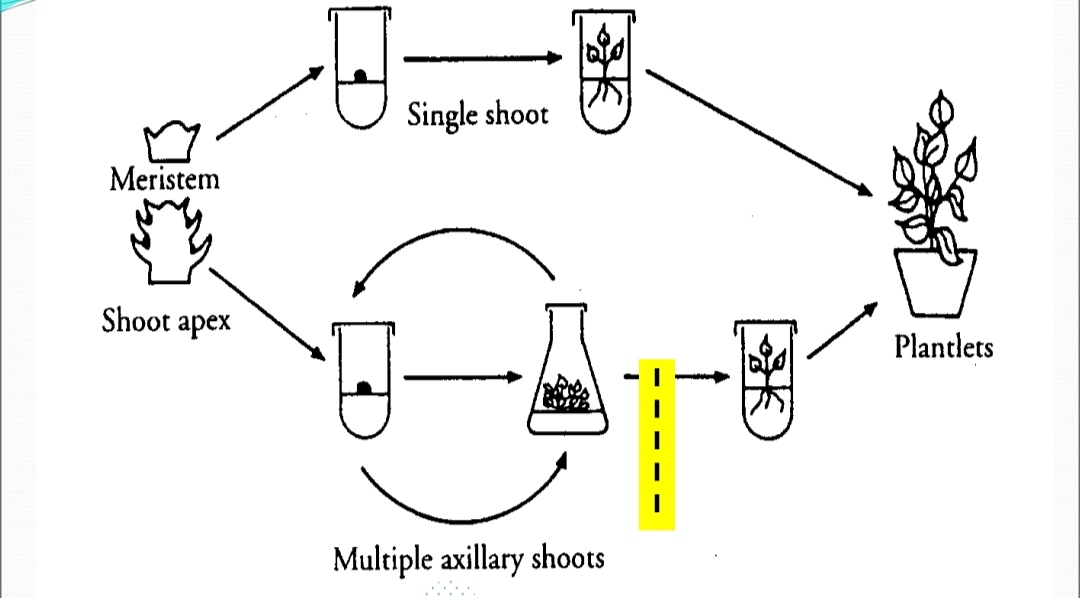
Steps of Micro-propagation
Stage 0 – Selection & preparation of the mother plant
- sterilization of the plant tissue takes place.
Stage I – Initiation of culture
- explant placed into growth media.
Stage II – Multiplication
- explant transferred to shoot mutiplicaton media; shoots can be constantly divided
Stage III – Rooting
- shoots transferred to rooting media
Stage IV – Transfer to soil
- explant returned to soil; hardened off
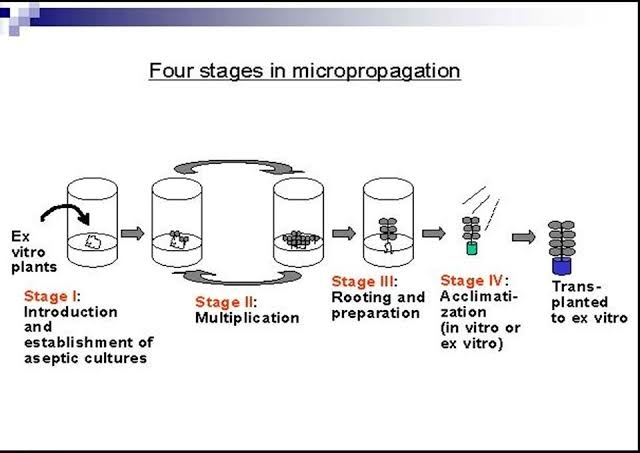
Culturing (micropropagating) Plant Tissue – the steps
Selection of the plant tissue (explant) from a healthy vigorous ‘mother plant’ – this is often the apical bud, but can be other tissue.
This tissue must be sterilized to remove microbial contaminants.
Handling Stock Plants:
A principal consideration for handling stock plants is reducing the potential for contamination by fungi, viruses and other pathogens.
Pathogens are not automatically eliminated by in vitro technique unless this goal is built into the system. Selected “virus-free” or pathogen-indexedstock plants should be used.
Explant:
• Cell, tissue or organ of a plant that is used to start in vitro cultures.
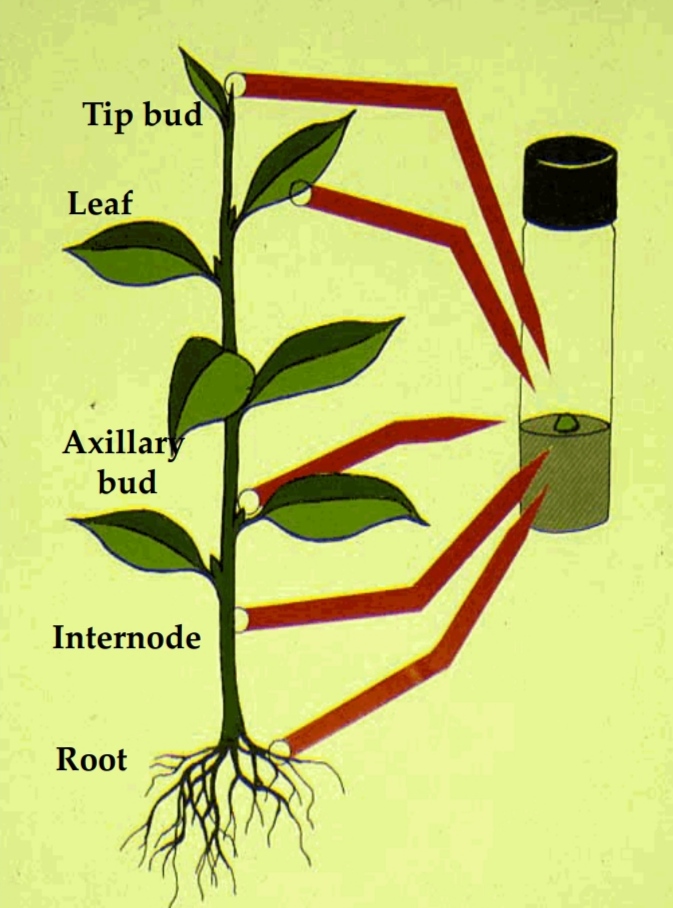
• Many different explants can be used for Micro-propagation, but axillary buds and meristems are most commonly used.
Choice of explant :
The kinds of explant and where and how they are collected varies with the purpose of the culture, the species, and often the cultivar.
Desirable properties of an explant:
✓Easily sterilizable, ✓Juvenile, ✓Responsive to culture, ✓Importance of stock plants;
✓Shoot tips, ✓Axillary buds, ✓Seeds, ✓Hypocotyl (from germinated seed), ✓Leaves.
Disinfestation:
Disinfestation is the process of removing contaminants from the surface of the explant. A typical procedure would be to cut the plant material into small pieces and wash them in running tap water. For materials that are difficult to disinfest, a quick dip in alcohol may be helpful. Wrapping the shoots with small squares of sterile gauze will hold them intact during the treatment.
Starting materials for Micro-propagation
Methods of Micro-propagation
| Axillary branching | • > 95% of all micropropagatio • Genetically stable • Simple and straightforward . |
| Adventitious shoot formation (organogenesis) | • Efficient but prone to genetic instability. |
| Somatic embryogenesis | • Little used. Potentially phenomenally efficient. |
Stage-II: Establish aseptic culture
- Establishment of the explant in a culture medium. The medium sustains the plant cells and encourages cell division. It can be solid or liquid.
- Each plant species (and sometimes the variety within a species) has particular medium requirements that must be established by trial and error.
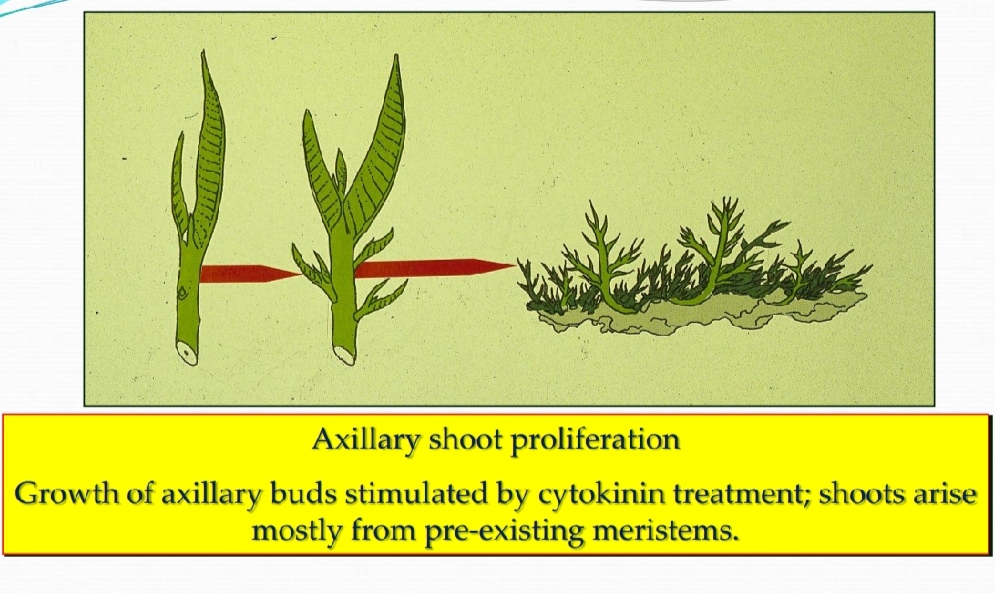
Axillary shoot proliferation
Growth of axillary buds stimulated by cytokinin treatment; shoots arise mostly from pre-existing meristems.
✓Clonal in vitro propagation by repeated enhanced formation of axillary shoots from shoot-tips or lateral meristems cultured on media supplemented with plant growth regulators, usually cytokinins.
✓Shoots produced are either rooted first in vitro or rooted and acclimatized ex vitro.

Stage-III: Multiplication
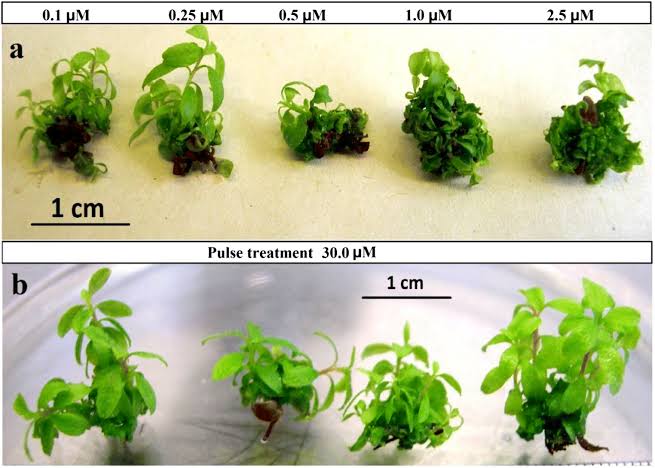
In the multiplication stage each explant has expanded into a cluster of micro shoots arising from the leaf axils or base of the explant. The separate microshoots are transplanted into a new culture medium, which is a process called subculturing.
During the multiplication stage, cultures are subcultured every 4 to 5 weeks. The kind of medium used depends on the species, cultivar, and type of culture. The basal medium is usually the same as in Stage-I, but often the cytokinin and mineral supplement level is increased.
Adjustments may need to be made after some experimentation.
• Subculture shoot clusters at 4 -5 week intervals
• 3 -8 fold increase in shoot numbers
• Number of subcultures possible is species/dependent.

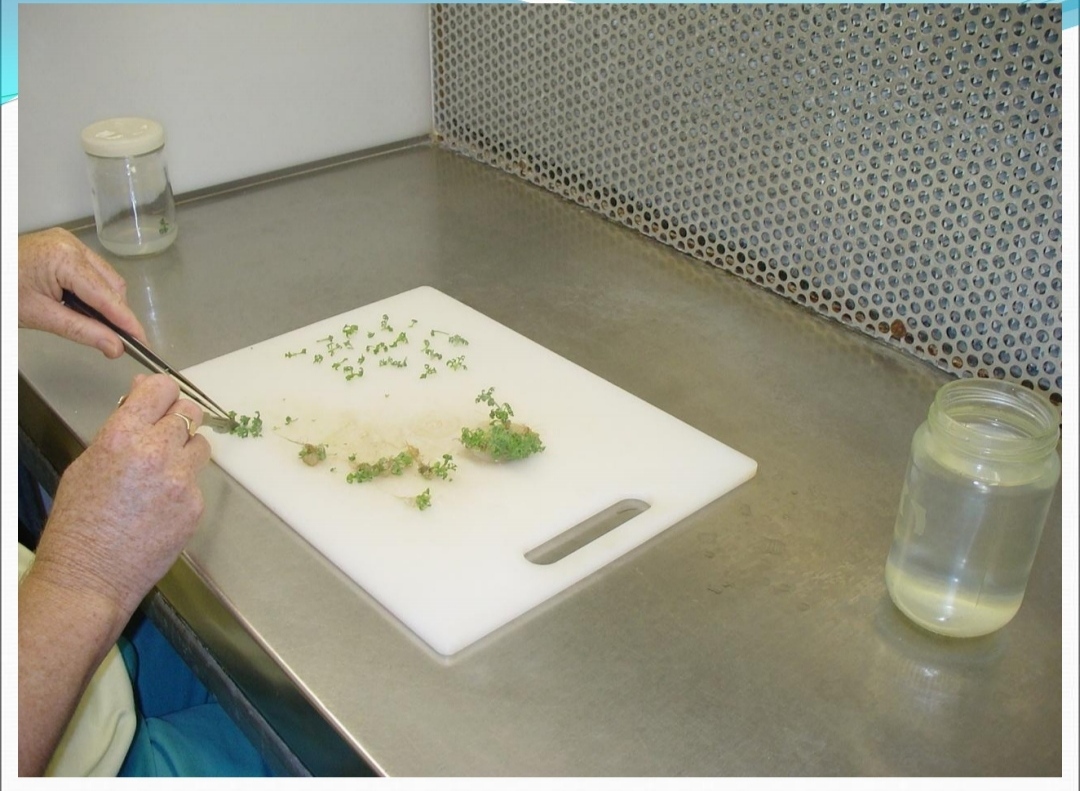
Dividing shoots:
Shoot elongation:
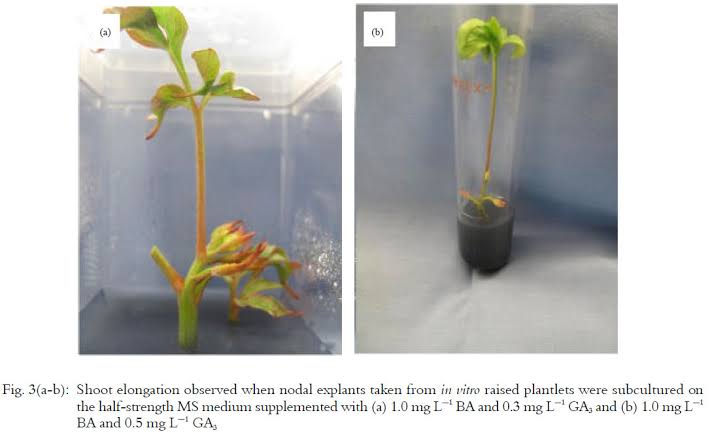
- Basal ‘hormone free’ medium
- Gibberellins
- Carry-overof hormones
Stage-III: Root induction/formation
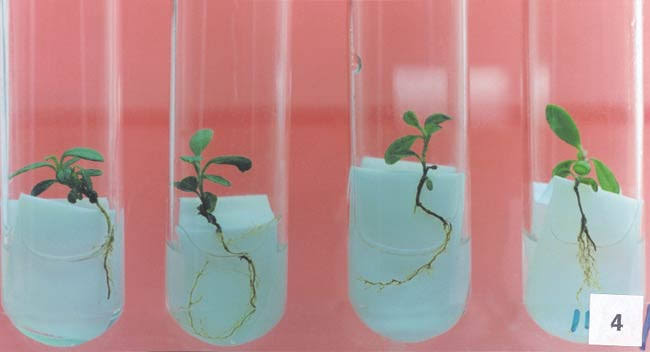
Shoots developed during the multiplication stage do not usually have roots. There are some exceptions (like African violet and poplar) that spontaneously root on the multiplication medium, but for most other species, single shoots (micro-cuttings) must be moved to a medium or suitable environment to induce roots.
Therefore, the purpose of Stage III is to prepare plantlets for transplanting from the tissue culture environment of the test tube to a free-living existence in the greenhouse and on to their ultimate location. Therefore, Stage III may not only involve rooting, but also conditioning the plantlet to increase its potential for acclimation and survival during transplanting, for example, by increasing agar and or sucrose concentration. Light intensity is sometimes increased during Stage III.
Some plants respond to an “elongation” phase between Stages II and III, achieved by placing the microshoot into an agar medium for 2 to 4 weeks without cytokinins (or at very low levels) and, in some cases gibberellic acid, which reduces the influence of cytokinin. The microshoots are then rooted in a cytokinin and GA-free medium.
Root initiation:
✓Auxins
✓Charcoal
✓C: N ratio
✓Light / darkness
✓Initiation vs growth
✓Juvenility / rejuvenation
✓Genotype
Goals:
• Preparation of Stage II shoots/shoot clusters for transfer to soil (prehardening),
• Elongation of shoots prior to ex vitro rooting ,
• Fulfilling dormancy requirements.
Stage-IV: Transfer to Natural Environment
Ultimate success of shoot culture depends on ability to acclimatize vigorously growing quality plants from in vitro to ex vitro conditions.
Once plantlets are well rooted, they must be acclimatized to the normal greenhouse environment. In vitro rooted plants are removed from the culture vessel and the agar is washed away completely to remove a potential source of contamination. Plantlets are transplanted into a standard pasteurized in a shaded, high humidity tent or under mist or fog.
Several days may be required for new functional roots to form. Plantlets should be gradually exposed to a lower relative humidity and higher light irradiance. Any dormancy or resting condition that develops may need to be overcome as part of the establishment process.
In summary, micropropagation involves the vegetative propagation of plants through (1) establishment, (2) multiplication, (3) rooting, and (4)acclimatization (transplanting) of clones in vitro starting with small explants and ending with a rooted plant established in a container or in the ground.
Acclimatization:
Process whereby plants physiologically and anatomically adjust from in vitro to ex vitro cultural and environmental conditions.
Two reasons micropropagated plants may be difficult to acclimatize ex vitro:
✓Low photosynthetic competence (heterotrophic nutrition)
✓Poor control of water loss; The rooted shoots are potted up (deflasked) and ‘hardened off’ by gradually decreasing the humidity .
This is necessary as many young tissue culture plants have no waxy cuticle to prevent water.