Plantlet The Blogging Platform of Department of Botany, University of Dhaka

Nomenclature, in biological classification, system of naming organisms. The species to which the organism belongs is indicated by two words, the genus and species names, which are Latinized words derived from various sources. This system, which is called the Linnaean system of binomial nomenclature, was established in the 1750s by Carolus Linnaeus. Subsequent to the work of Linnaeus, a proliferation of binomial names took place as new species were established and higher taxonomic categories were formed, with the result that by the late 19th century there was much confusion in the nomenclature of many groups of organisms. In the 20th century, the establishment of rules by international committees in the fields of zoology, botany, bacteriology, and virology has done much to clarify the situation.
What is nomenclature?
- Botanical nomenclature is the formal, scientific naming of plants. It is related to, but distinct from taxonomy. Plant taxonomy is concerned with grouping and classifying plants; botanical nomenclature then provides names for the results of this process.
- Binomial nomenclature (“two-term naming system”), also called binominal nomenclature (“two-name naming system”) or binary nomenclature, is a formal system of naming species of living things by giving each a name composed of two parts, both of which use Latin grammatical forms, although they can be based on words from other languages. Such a name is called a binomial name (which may be shortened to just “binomial”), a binomen, binominal name or a-scientific name; more informally it is also called a Latin name.
- The first part of the name – the generic name – identifies the genus to which the species belongs, while the second part – the specific name or specific epithet – identifies the species within the genus. For example, humans belong to the genus Homoand within this genus to the species Homo sapiens. Tyrannosaurus rex is probably the most widely known binomial. The formal introduction of this system of naming species is credited to Carl Linnaeus, effectively beginning with his work Species Plantarum in 1753.[2] But Gaspard Bauhin, in as early as 1622, had introduced in his book Pinax theatri botanici (English, Illustrated exposition of plants) many names of genera that were later adopted by Linnaeus.
- The application of binomial nomenclature is now governed by various internationally agreed codes of rules, of which the two most important are the International Code of Zoological Nomenclature (ICZN) for animals and the International Code of Nomenclature for algae, fungi, and plants (ICNafp). Although the general principles underlying binomial nomenclature are common to these two codes, there are some differences, both in the terminology they use and in their precise rules.
- In modern usage, the first letter of the first part of the name, the genus, is always capitalized in writing, while that of t he second part is not, even when derived from a proper noun such as the name of a person or place. Similarly, both parts are italicized when a binomial name occurs in normal text (or underlined in handwriting). Thus the binomial name of the annual phlox (named after botanistThomas Drummond) is now written as Phlox drummondii.
- In scientific works, the authority for a binomial name is usually given, at least when it is first mentioned, and the date of publication may be specified in botany,
- “Amaranthus retroflexus L.” – “L.” is the standard abbreviation used in botany for “Linnaeus”.
- “Hyacinthoides italica (L.) Rothm.” – Linnaeus first named this bluebell species Scilla italica; Rothmaler transferred it to the genus Hyacinthoides; the ICNafp does not require that the dates of either publication be specified.
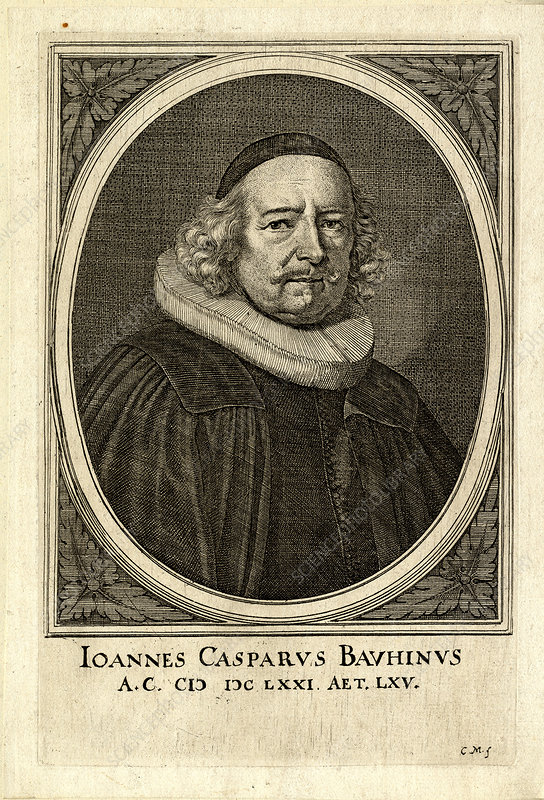
Caspar Bauhin (Latin: Casparus Bauhinus; 17 January 1560 – 5 December 1624), was a Swiss botanist whose Pinax theatri botanici (1623) described thousands of plants and classified them in a manner that draws comparisons to the later binomial nomenclature of Linnaeus.
What is ICBN or ICN
- The International Code of Botanical Nomenclature (ICBN) is the set of rules and recommendations dealing with the formal botanical names that are given to plants. Its intent is that each taxonomic group (“taxon”, plural “taxa”) of plants has only one correct name that is accepted worldwide.
- The 18th Botanical Congress was held in Melbourne, 2011 and The Congress changed the ICBN to ICN (International Code of Nomenclature).
History of ICBN
- It was Linnaeus who proposed the elementary rules of naming plants first in 1737 in his Critica botanica and then in 1751 in Philosophia Botanica.
- Elementary rules were framed to serve as a guide to botanists. Later in 1813, A.P. de Candolle in his Theories elementary de la botanique gave a detailed set of rules regarding plant nomenclature.
- It was then that Alphonse de Candolle, son of A.P. de Candolle convened an assembly of botanists of several countries to present a new set of rules. Candolle convened the First International Botanical Congress held at Paris in 1867.
- Subsequent meetings of the International Botanical Congress were held in 1892 (Rochester Code), 1905 (Vienna Code), 1907 (American Code) and 1910, but a general agreement regarding the internationally acceptable rules of plant nomenclature was reached in 1930 at the IBC meeting at Cambridge where for the first time in botanical history, a code of nomenclature came into being
that was international in function as well as in name. - This code is called the International Code of Botanical Nomenclature (ICBN). The modifications or amendments as suggested by the International Botanical Congress at the subsequent meetings have been incorporated in the ICBN on a regular basis.
- The ICBN sets the formal starting date of plant nomenclature at 1 May 1753, the publication of Species Plantarum by Linnaeus .
DIVISION I. 6 PRINCIPLES
- Principle I: Botanical nomenclature is independent of zoological and bacteriological nomenclature. The Code applies equally to names of taxonomic groups treated as plants whether or not these groups were originally so treated
- Principle II: The application of names of taxonomic groups is determined by means of nomenclatural types.
- Principle III: The nomenclature of a taxonomic group is based upon priority of publication.
- Principle IV: Each taxonomic group with a particular circumscription, position, and rank can bear only one correct name, the earliest that is in accordance with the Rules, except in specified cases.
- Principle V: Scientific names of taxonomic groups are treated as Latin regardless of their derivation.
- Principle VI: The Rules of nomenclature are retroactive unless expressly limited.