Plantlet The Blogging Platform of Department of Botany, University of Dhaka
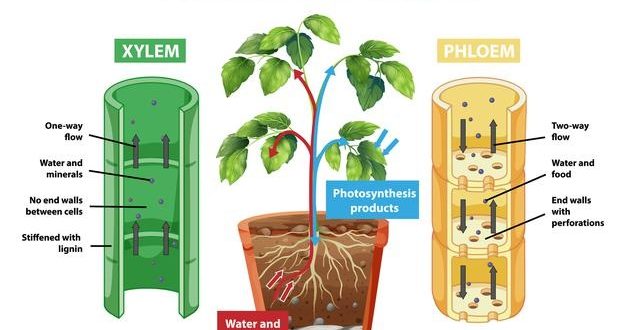
The vascular tissue system consists of a number of vascular bundles which are found to be distributed in the stele. The stele is the central cylindrical portion of the stem and root, commonly surrounded by endodermis, and consists of vascular bundles, pericycle, pith and medullary ray. Each vascular bundle consists of xylem and phloem tissues with or without cambium. In root, separate xylem and phloem strands are found.
Function
The function of this system is to conduct water and other nutrients from roots to leaves through the xylem and translocation of prepared carbohydrates from leaves to other storage organs and growing regions of plant body through the phloem.
The Vascular Bundle
Origin: Vascular elements are derived from the procambial strands of the primary meristem.
Arrangement: The vascular bundle may be arranged in circular ring as in dicotyledonou

s stems and the roots, on the other hand, they are found to be scattered throughout the axis in the monocotyledonous stems. In certain plants the vascular bundle remain scattered within the well-defined pith. Such bundles are called medullary vascular bundles ( e.g., Mirabilis, Boerhaavia, Bougainvillaea, Achyranthes, Amaranthus). Vascular bundle may occur in the cortical region of the stem, such bundles are known cortical bundles ( e.g., Casuarina, Nyctanthes).
Constituent of a Vascular Bundle
A vascular bundle of dicotyledonous stem consists of three major zones –
- Xylem or wood
- Phloem or bast
- Cambium
Xylem or Wood
The xylem of a vascular bundle lies towards the centre and is composed of
- Vessel or tracheae
- Tracheids
- Wood fibres
- A patch of xylem or wood parenchyma
- The vessel may possess various kinds of thickenings such as annular, spiral, scalariform, reticulate and pitted.
- The tracheid is also found to be associated with vessels. In a similar way, wood fibres and wood parenchyma are also found.
- The xylem or wood parenchyma of secondary wood usually becomes thick-walled and lignified.
Function
- The xylem elements, i.e., vessels and tracheid, aid in the conduction of water and mineral salts from the roots of the leaves.
- Wood or xylem parenchyma is living tissue, and aid in storage.
- The wood fibre gives mechanical support to the plant body.
Exarch
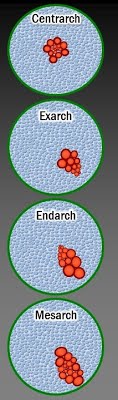
When the development of xylem takes place towards the centre of the axis, or in other words, the protoxylem develops towards the periphery, it is called centripetal xylem, and the xylem strand is said to be exarch. For example, the stem of root plants is always exarch; the stem club mosses ( Lycopodium spp.) is exarch.
Endarch
If the development of xylem takes place towards the periphery of the axis, or in other words, protoxylem elements develop towards the centre, it is called centrifugal xylem, and the xylem unit is said to be endarch. . For example, the stem of seed plants is endarch.
Mesarch
When the development is such that both centripetal and centrifugal xylem are formed, the xylem is mesarch. For example; mesarch xylem is commonly found in the ferns and the hypocotyl region of angiospermic seedings.
Protoxylem
The first cells of the xylem to mature are collectively called the protoxylem.
Characteristics:
- The protoxylem is complex tissue made up of tracheid vessels and parenchyma cells,
- The protoxylem consists of annular spiral and scalariform vessels which may stretch in length very easily,
- In the stem, it lies towards the centre of axis whereas in the root it lies towards periphery.
- The vessels of protoxylem have smaller cavities.
Metaxylem
The xylem which develops afterwards and possesses reticulate and pitted vessels and some tracheid is called metaxylem.
Characteristics:
- In the roots towards the centre.
- The vessels of metaxylem have bigger and wider cavities.
Phloem or Bast

Usually, in stems, phloem is found away from the centre of the axis towards the periphery and consists of sieve tubes or sieve cells only, or sieve tubes and companion cells only, or sieve tubes, companion cells and phloem parenchyma.
- In Gymnosperm it is represented by sieve cells only.
- In most monocotyledons, it consists of sieve tubes and companion cells only.
- whereas in dicotyledons, sieve tubes, companion cells and phloem parenchyma possess simple pits in their walls, particularly which lie against the sieve tubes.
- All phloem elements are living and formed of cellulose. In certain cases, the primary phloem is capped by a patch of sclerenchyma called hard bast as in the Helianthus
Functions
- Phloem serves for translocation of prepared carbohydrates from leaves to the storage tissue and other growing regions.
- Sieve tubes translocate proteins and some other carbohydrates.
- Phloem parenchyma conducts amines, amino acids and soluble carbohydrates and companion cells also translocate many soluble food materials.
Protophloem
The first cell of the phloem to mature are known as protophloem. The protophloem consists of narrow sieve tubes and is found towards periphery.
Metaphloem
The metaphloem is a complex tissue and consists of well-developed cells of all types such as sieve tubes, companion cells, phloem parenchyma and sometimes phloem fibres and sclereids.
Cambium
In between xylem and phloem, a thin strip of primary meristem is found in dicotyledonous stems, called the cambium.
Characteristics
- The cells of cambium are rectangular and thin-walled.
- The cambium strip may be uniseriate or multilayered.
- The cambial cells are living, sufficiently elongated and possess oblique ends, but as they become flattened tangentially they look rectangular in cross-section.
Types of Vascular Bundle
A vascular bundle consists of a strand-like portion having xylem and phloem of the primary vascular system. According to the arrangement of xylem and phloem in the vascular bundles are of the following type: 1)Radial, 2)Conjoint and 3)Concentric.
- Radial: Those in which the xylem and the phloem lie radially side by side (e.g., in roots of seed plants). This is the most primitive type.
- Conjoint: Those in which the two types of tissues are separated from one another. Xylem and phloem together form a bundle. The two
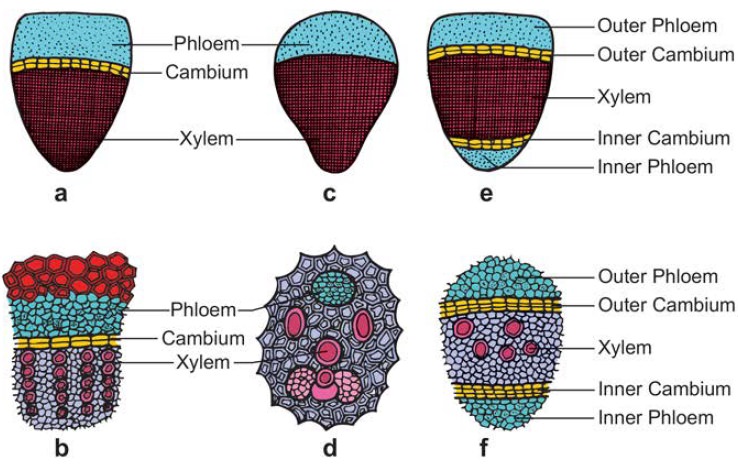
Types of Vascular Bundle. Source: Brainkart.com subtypes are a) Collateral b) Bicollateral.
- Collateral: Xylem and phloem lie together on the same radius in the
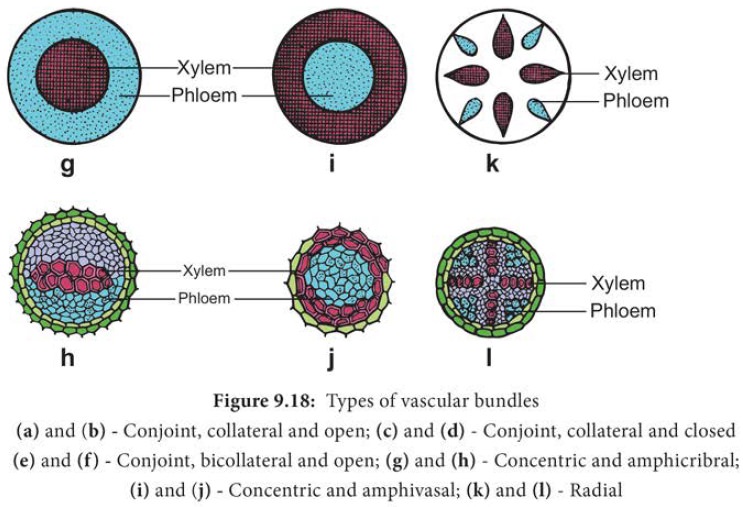
Types of Vascular Bundle. Source: BrainKart.com. position that xylem lies inwards and phloem outwards. Phloem occurs on one side of the xylem strand. In dicotyledons stem, cambium is found to be present xylem and phloem, such bundles are called open (e.g., Helianthus) and when the cambium is absent it is called closed (e.g., in monocotyledon stem).
- Bi-collateral: Phloem is found to be present on both sides of xylem. Simultaneously two cambium strips also occur. Various elements are arranged in the following sequence – outer phloem, outer cambium, xylem, inner cambium and inner phloem. Such bundles are commonly found in the members of Cucurbitaceae.
- Concentric: Those in which one type of tissue surrounds, or ensheaths, the other. Such bundles are always closed. The concentric bundles may be of two subtypes-
- Amphivasal: If the xylem surrounds the phloem (e.g., Dracaena).
- Amphicribal: If the phloem surrounds the xylem (e.g., Fern).
Stelar System
The stele is defined by or as a central vascular cylinder with or without pith and delimited the cortex by endodermis. The term stele has been derived from a Greek word meaning pillar. The stele may be of the following types:
-
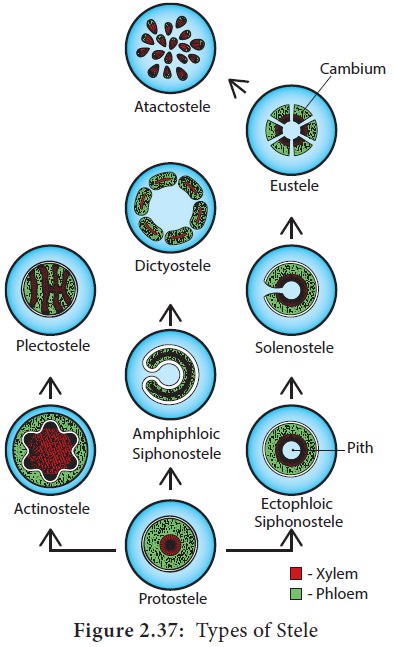
Types of stele. Source: BrainKart.com. Protostele
The primitive type of stele is protostele. Here, the vascular tissue is a solid mass and the central core of the xylem is completely surrounded by the strand of phloem. This is the most primitive and simplest type of stele.
There are several forms of protostele:
i. Haplostele
This is the most primitive type of protostele. Here the central solid smooth core of xylem remains surrounded by phloem (e.g., Selaginella spp.).
ii. Actinostele
This is the modification of haplostele and somewhat more advanced in having the central xylem core with radiating ribs (e.g., Psilotum spp.)
iii. Plectostele
This is the most advanced type of protostele. Here the central core of xylem is divided into number of plates arranged parallel to each other. The phloem alternate with the xylem (e.g., Lycopodium).
iv. Mixed-pith stele
Here the xylem elements (i.e., tracheids) are mixed with the parenchymatous cells of the pith. This type is found in primitive fossils and living forms. They are treated to be the transitional types in between true protosteles on the one hand and siphonosteles on the other (e.g., Gleichenia spp. and Osmunda spp.).
-

Types of Stele. Source: Biology Discussion. Siphonostele
This is the modification of protostele. A stele in which the protostele is medullated is known as siphonostele. Such stele contains a tubular vascular region and a parenchymatous central region. Jeffrey (1898) interpreted that the vascular portion of siphonostele possesses a parenchymatous area known as a gap immediately above the branch traces only in or immediately above leaf or branch traces.
A siphonostele may be of following types:
- Ectophloic: The pith is surrounded by concentric xylem cylinder and next to xylem the concentric phloem cylinder.
- Amphiphloic: The pith is surrounded by the vascular tissue. The concentric inner phloem cylinder surrounds the central pith. Next to the inner phloem is the concentric xylem cylinder which is immediately surrounded by outer phloem cylinder (e.g., in Marsilea).
-
Solenostele
The vascular plants have been divided into two groups based on the presence or absence of the leaf gaps. These groups are Ptreopsida and Lycopsida. The ferns, gymnosperms and angiosperms are included in Pteriopsida, whereas the Lycopods, horse-tails, etc., are included in Lycopsida. The simplest form of siphonostele has no gaps, e.g., Selaginella.
-
Dictyostele

In the more advanced siphonosteles of Pteriopsida, the successive gaps may overlap each other. Brebner (1902) called the siphonosteles with overlapping gaps as dictyosteles.
-
Polycyclic stele
This type of stele organization is the most complex one amongst all vascular cryptogams (pteridophytes). Such types of steles are siphonostelic in structure. Each stele possesses an internal vascular system connected with the outer siphonostele. Such connections are always found at the node.
-
Eustele
According to Brebner (1902), There is one more modification of siphonostele known as eustele. Vascular system consists of a ring of collateral or bicollateral vascular bundle situated on the periphery of pith. Interfascicular areas and leaf gaps are not distinguished from each other very clearly (eg., Equisetum).
Related Links
References
- Plant Anatomy by B.P. Pandey.