Plantlet
Cryptogams, Evolution
170,320
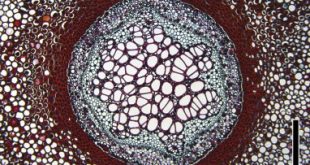
A stele is the central cylinder or core of vascular tissue in higher plants and Pteridophytes. It consists of the xylem, phloem, pericycle, medullary rays, and pith if present. The term stele has been derived from a Greek word meaning rod or column. Van Tieghem and Douliot (1886) introduced this …
Read More »
Plantlet
Cryptogams
12,729
The word cryptogams is a synthesis of two Greek terms kruptos meaning ‘hidden’ and gamos meaning ‘wedded’. This single term encompasses all plants that reproduce by means of spores and, do not produce seeds. The algae, fungi, bryophytes and pteridophytes are all cryptogams. The pteridophyta are treated as vascular cryptogams …
Read More »
Plantlet
Cryptogams
36,225
The term Pteridophyta was first coined by Haeckel. Eichler (1883) divided the plant kingdom into Cryptogamia and Phanerogamia. The Cryptogamia was further divided into Thallophyta. Bryophyta and Pteridophyta. Engler (1909) included the Bryophyta and Pteridophyta under Embryophyta. Due to discovery of the fossil plants, the classification of Pteridophytes has undergone …
Read More »
Plantlet
Cryptogams, Evolution
39,280
They are the earliest known vascular plants that originated in the Silurian period (400 million years ago) of the Palaeozoic Era and subsequently diversified and formed the dominant vegetation on earth during Devonian to Permian period. There are controversies regarding their origin and evolution. There are two broad theories about …
Read More »
Plantlet
Cryptogams
18,154
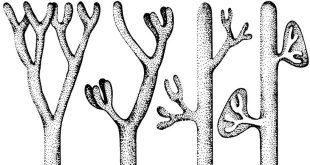
Telome theory was proposed by Walter Zimmerman (1952, 1965). This theory is based on fossil records and explains the major steps in the evolution of vascular plants. According to this theory, all vascular plants have evolved from simple, leaf-less, root-less and dichotomously branched sterile and fertile axes called telomes which …
Read More »
Tarek Siddiki Taki
Fungi
10,279
In the kingdom Fungi, there are two major phyla- Ascomycota and Basidiomycota. These two together form a subkingdom of fungi named as Dikarya. They together were named such as members of both phyla maintain most part of their life cycle in dikaryotic stage meaning each cell contains two genetically different …
Read More »
Plantlet
Angiosperm
2,749
Modern embryology seems to comprise three main disciplines. The first, or descriptive embryology, is a study of the various developmental processes that take place in a plant from the initiation of the sex organs to the maturation of the embryo. The second, or phylogenetic embryology, attempts to evaluate these data …
Read More »
Plantlet
Angiosperm
5,523
The phenomenon of polyembryony, i.e., the occurrence of more than one embryo in a seed, has attracted much attention ever since its initial discovery in the orange (Citrus sinensis) by Leeuwenhoek (1719). Ernst (1918) and Schnarf (1929), who have reviewed the older literature, classify it into two types—”true” and “false”—depending …
Read More »
Plantlet
Angiosperm
6,896
Apomixis maybe defined (Winkler, 1908, 1934) as the substitution for sexual reproduction (amphimixis) of an asexual process which does not involve any nuclear fusion. For the sake of convenience it may be subdivided into four classes. Non-recurrent apomixis Recurrent apomixis Adventive embryony Vegetative propagation Non-recurrent apomixis In the first, or …
Read More »
Plantlet
Angiosperm
5,254
Fertilization is the union of male and female gametes to produce a zygote. There are several steps of fertilization. They are described below. Germination of Pollen. The course of the pollen tube. Entry of pollen tube into the ovule. Entry of pollen tube into the embryo sac. Gametic fusion. Germination …
Read More »
 Plantlet The Blogging Platform of Department of Botany, University of Dhaka