Classic Layout

Psilotum: The Whisk Fern

Psilotum is commonly known as Whisk-fern. Salient features of Pilotum The sporophytes are dichotomously branched with an underground rhizome and upright branches. The upright branches are leafless. Rhizoids are present instead of root. Stem has a relatively simple vascular cylinder. The sporangia are born in groups (trilocular) and form synangia. …

Read More »

Introduction to Pteridophyta

The word cryptogams is a synthesis of two Greek terms kruptos meaning ‘hidden’ and gamos meaning ‘wedded’. This single term encompasses all plants that reproduce by means of spores and, do not produce seeds. The algae, fungi, bryophytes and pteridophytes are all cryptogams. The pteridophyta are treated as vascular cryptogams …

Read More »

Pteridophytes: Classification of Pteridophyta

The term Pteridophyta was first coined by Haeckel. Eichler (1883) divided the plant kingdom into Cryptogamia and Phanerogamia. The Cryptogamia was further divided into Thallophyta. Bryophyta and Pteridophyta. Engler (1909) included the Bryophyta and Pteridophyta under Embryophyta. Due to discovery of the fossil plants, the classification of Pteridophytes has undergone …

Read More »

Pteridophytes: Origin and Evolution

They are the earliest known vascular plants that originated in the Silurian period (400 million years ago) of the Palaeozoic Era and subsequently diversified and formed the dominant vegetation on earth during Devonian to Permian period. There are controversies regard­ing their origin and evolution. There are two broad theories about …

Read More »

Evolution of Plants: Telome Theory

Telome theory was proposed by Walter Zimmerman (1952, 1965). This theory is based on fossil records and explains the major steps in the evolution of vascular plants. According to this theory, all vascular plants have evolved from simple, leaf-less, root-less and dichotomously branched sterile and fertile axes called telomes which …

Read More »

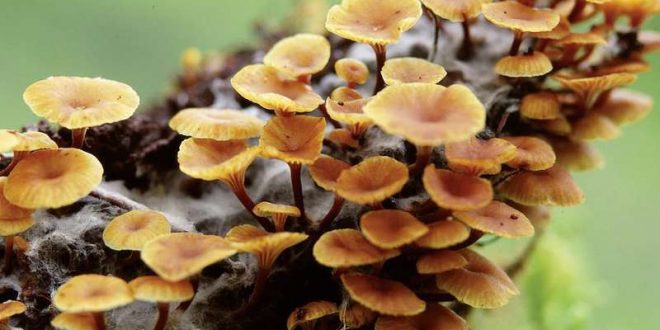
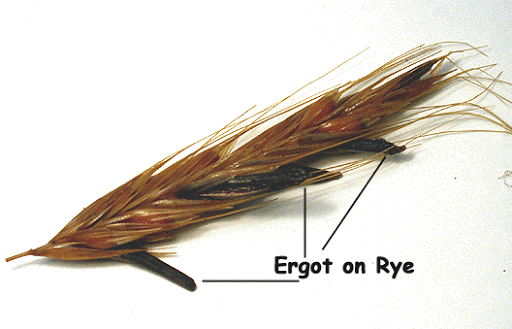
Identification Of Ascomycetes: The Sac Fungi

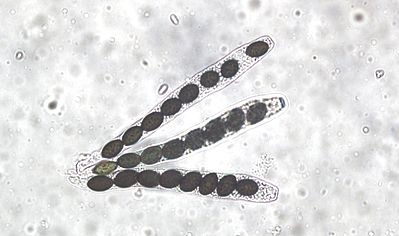
In the kingdom Fungi, there are two major phyla- Ascomycota and Basidiomycota. These two together form a subkingdom of fungi named as Dikarya. They together were named such as members of both phyla maintain most part of their life cycle in dikaryotic stage meaning each cell contains two genetically different …

Read More »

Polyembryony: Multiple Embryos in a Seed

The phenomenon of polyembryony, i.e., the occurrence of more than one embryo in a seed, has attracted much attention ever since its initial discovery in the orange (Citrus sinensis) by Leeuwenhoek (1719). Ernst (1918) and Schnarf (1929), who have reviewed the older literature, classify it into two types—”true” and “false”—depending …

Read More »

Apomixis: A Subistitution for Sexual Reproduction

Apomixis maybe defined (Winkler, 1908, 1934) as the substitution for sexual reproduction (amphimixis) of an asexual process which does not involve any nuclear fusion. For the sake of convenience it may be subdivided into four classes. Non-recurrent apomixis Recurrent apomixis Adventive embryony Vegetative propagation Non-recurrent apomixis In the first, or …

Read More »
0
Would love your thoughts, please comment.x
()
x