Organisms living together in a community influence each other directly or indirectly under natural conditions. All vital process of living such as growth, nutrition, reproduction required interactions between individuals of same species, or between species which are inter and intra-related. Such relationships of individuals in a population of an ecosystem …
Read More »Polysaccharides: The Long Chain of Simple Sugars
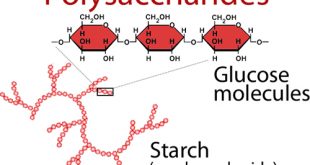
Polysaccharides are polymeric carbohydrate molecules composed of long chains of monosaccharide unit bound together by glycosidic linkage. Example: starch, glycogen, cellulose, chitin etc. Characteristics of polysaccharide On hydrolysis, they yield monosaccharide units which are usually similar. D glucose is the commonest component of polysaccharide. They have high molecular weight. They …
Read More »Disaccharides: Bonding of Two Simple Sugars
A disaccharide, also called double sugar, is the sugar formed when two monosaccharides (simple sugars) are joined by a glycosidic linkage. Like monosaccharides, disaccharides are soluble in water. Three common examples are sucrose, lactose, and maltose. Disaccharides are one of the four chemical groupings of carbohydrates (monosaccharides, disaccharides, oligosaccharides, and polysaccharides). The most common …
Read More »Protein: Discovery, Characteristics, and Structures
The word protein refers to a type of molecule in food that can be broken down into amino acids. They are biochemical compounds consisting of one or more polypeptides typically folded into a globular or fibrous form, facilitating a biological function. Protein accounts on average about 1/4th to 1/3rd of …
Read More »Cytotaxonomy: Study of Chromosome Behaviour
Chromosome behaviour is an important factor that determine the pattern of variation and taxonomic distinctness. Pairing behavior and subsequent separation of chromosome occurs at meiosis. In reporting results of pairing studies, univalents are represented by Is, bivalents by IIs, etc. Some taxonomic information can be gained from the study of …
Read More »Cytotaxonomy: Study of Chromosome Structure
Study of chromosome structure is very important in cytotaxonomic studies. It includes chromosome size, shape and position of centromere (i.e. arm-length ratio of each chromosome in the genome) Chromosomal size and shape are also important as taxonomic criteria in taxonomy. For examples, The chromosomal ratio if Mediola and Trillium of …
Read More »DNA Replication in Eukaryotes: Linear Replication
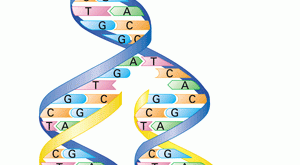
DNA replication in eukaryotes is a complex and unique process involving many enzymes and thousands of ORI at a single time. Unlike the prokaryotic DNA, it involves a linear mode of replication. Why does linear DNA replication involve multiple origins at a time? The large linear chromosomes in eukaryotic cell …
Read More »Replication in Circular DNA: Theta Model
Following Meselson and Stahl’s work, investigators confirmed that other organisms also use semiconservative replication. There are, however, several different ways that semiconservative replication can take place, differing principally in the nature of the template DNA—whether it is linear or circular—and in the number of replication forks. Replicon and Origin of …
Read More »Chromosome Number: A Great Tool in Taxonomic Studies
Taxonomy – is the branch of biology that deals with identification, nomenclature and classification of an object. Cytology – is the branch of biology that deals with origin, structure and function of cell. So Cytotaxonomy presumably means the application of cytological data to taxonomy. More precisely we can say Cytotaxonomy …
Read More »Translation: mRNA to Protein
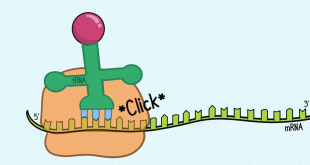
Translation takes place on ribosomes; indeed, ribosomes can be thought of as moving protein-synthesizing machines. A ribosome attaches near the 5′ end of an mRNA strand and moves toward the 3′ end, translating the codons as it goes. Synthesis begins at the amino end of the protein, and the protein …
Read More »
Plantlet The Blogging Platform of Department of Botany, University of Dhaka