Nusrat Jahan
Taxonomy
4,035
Systematic position Bentham and Hooker placed it in the sub-class Gamopetalae,the series Bicarpellate and Cohort Gentianales . According to Engler it belongs to the sub-class Metachlymadeae, the sub-order Gentianineae under the order Controtae.Hutchinson places it under the order Apocynales of the Phylum Lignosae. Distribution The family contains about 300 genera …
Read More »
Nusrat Jahan
Taxonomy
4,982
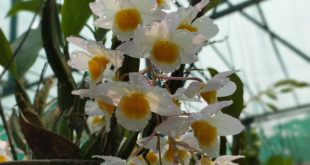
Systematic position According to Bentham and Hooker it belongs to the series Microspermae. Engler places it under the order Microspermae.Hutchinson considers it as belonging to the order Orchidales of the divison Corolliferae. Distribution The family is large and is consisting of over 400 genera and more than 10,ooo species distributed …
Read More »
Nusrat Jahan
Taxonomy
6,119
Systematic position Bentham and Hooker places this family under the series Glumaceae of the Monocotyledons. According to the Engler it belongs to the order Glumiflorae. Hutchinson places it under the order Graminales belonging to the division Glumiflorae. Distribution The members of this family is cosmopolitan and grow on almost all …
Read More »
Plantlet
Physiology
12,491
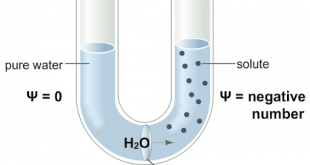
Concept of water potential Free energy per mole is the chemical potential. The water potential is the chemical potential of a water solution in a system minus the chemical potential of pure water at atmospheric pressure and at the same temperature. A system’s water potential expresses its ability to do …
Read More »
Plantlet
Uncategorized
8,807
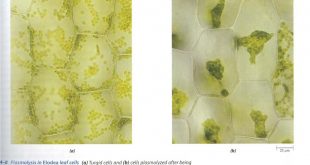
Isotonic, Hypotonic and Hypertonic solution Case A In the cell, Concentration = .1mMol L-1 Ψp is negligible or 0 In the solution of the container, Concentration = .1mMol L-1 Ψp = 0 In both cases, Ψw = Ψπ + Ψp = -CRT (Ψp is 0 or negligible) Comment: There will …
Read More »
Plantlet
Physiology
18,092
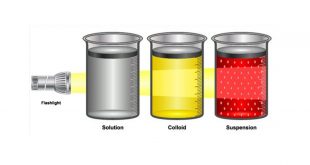
Chemistry is about combining different substances. Sometimes combining substances can cause a chemical reaction and bonding. This creates an entirely new substance called a compound. However, sometimes when there is no chemical reaction or bonding, it forms only a mixture. A mixture is made when two or more substances are …
Read More »
Ahmmod Awal Dipon
Genetics
15,011
If you have read the first and second part you may have understood that this is our third and final part. In this part we are going to discuss Monohybrid, dihybrid and trihybrid inheritance, Back cross and test cross and Probability in Mendelian inheritance, Chi-square test. So let’s not waste …
Read More »
Plantlet
Physiology
4,139
Properties of water Most of the unique properties of water are ascribed to the H bond formed between polar water molecules. The two H atoms are angled at 105° in a water molecule (?). 1. Surface tension Surface tension results due to forces of attraction existing between the molecules …
Read More »
Khaleda Akter
Cytology
3,431
As human beings are social creatures, they live in a social environment. If we look around us, we can see mainly two types of things in the environment. One is living things & another is non-living things. Living things are those which possess life. Now, what is life? It’s not …
Read More »
Ahmmod Awal Dipon
Genetics
5,279
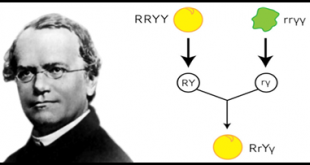
In this article we will discuss (c) Life of Gregor Johann Mendel, his experiments and achievements; reasons of Mendels success. Gregor Johann Mendel who is the father of genetics, was born in 1822. In this article we will know him and his works elaborately. Life of Gregor Johann Mendel, His …
Read More »
 Plantlet The Blogging Platform of Department of Botany, University of Dhaka