Blog Layout

The Age of Bacteria

Planet Earth is about 4.55 billion years old. A sense for this achingly long time grew only slowly throughout the nineteenth century as geological and biological inquiry unravelled the pattern and processes of the planet’s natural environment. The 4.55 billion figure derives from the decay of radioactive forms of elements …

Read More »

Relation of Climate and Biodiversity and its threat

Climate & Biodiversity ■ Regional climate interacts with regional biota & substrate to produce large, easily recognizable community units called “Biomes“. ■ Climatic climax biodiversity has been found in “Biome“. ■ In biomes life forms reflects major features of climate & determines structural nature of habitats for animals. ■ Provides …

Read More »

Agaricales: Agarics & Boletes

Agaricales is an order of fungi in the class Agaricomycetes (phylum Basidiomycota, kingdom Fungi). It is one of the most diverse orders of the phylum Basidiomycota. Traditionally, agarics were classified based on the presence of gills (thin sheets of spore-bearing cells, or basidia) and mushroom-shaped fruiting bodies. Some other conspicuous …

Read More »

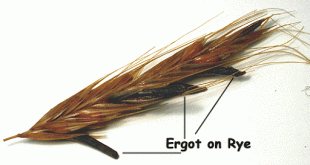
Clavicipitales: Ergot by Claviceps Purpurea

Claviceps are member of the pyrenomycetes, fungi which are referred when they form perithecial ascocarp. They are important as the parasites of many endophytes in their life as discussed below- Classification Class: Ascomycetes Sub-class: Hymenomycetidae I, Hymenomycetidae II. Order: Hypocreales Family: Clavicipitaceae Genus: Claviceps Vegetative structure The intercellular hyphae are …

Read More »
0
Would love your thoughts, please comment.x
()
x